Showing posts with label set design. Show all posts

Friday, June 7, 2013

Merchant Building

Saw this side of a building in Lancaster, PA, a couple of weeks ago. What great set potential for Merchant of Venice. Stairs, windows, doors to nowhere, piping, gutters, stone, brick, lines, curves, angles—it's got it all.

Tuesday, June 4, 2013

Fencing and Rivets!

Passed by this combo chain-link/iron-pipe fence in Manhattan yesterday. Loved the industrial look (next to grommets, rivets are my favorite!) as a possibility in my Merchant set research. Look for this in my set design.

Monday, June 3, 2013

Merchant Lettering


In the midst of Merchant research I came across these letters at an abandoned show in downtown Lancaster, PA. It was a menswear shop. I love the look of these. Perhaps one is a perfect look for a 1950s Merchant of Venice.

Thursday, January 31, 2013

Nifty Fifties

kitchen/living room—plastic plant, linoleum, perfect!

kitchen—enjoyed picking wallpaper, coffee pot, toaster,
breadbox, kitschy knick-knacks, etc.

living room—note the working 50s television
These are set shots for a show I'm directing entitled Break the Knot. The play is set in 1959. I did the scene design about 6 years ago, and I still like it. (Note the ghosted image of the year on the cabinets—we're working on getting that tweaked and onto the stage right cabinets.) The pictures don't do the 50s aqua colored cabinets and frig justice. I searched flea markets and antique shops from Greenville to St. Louis. My kids still talk about a road trip on which we packed nearly every square inch of our SUV with kitschy stuff—frames, vases, telephone, lamps, dishes, canisters, pictures, a vintage typewrite, etc., etc. I don't do semi-realism often, but when I do, it sure satisfies my junk itch.

The show is tonight (1/31/13) at 7:00 and 8:30. It runs just under an hour with no intermission.

Wednesday, January 23, 2013

Who Knew?


Who knew that teabags could make such a great visual? Saw this display at an Anthropology store a while back and decided to post for inspiration. Style on the cheap. This could be done even on a schoolteacher's budget.

Imagine a garment out of these. . . .

But don't even think about where they've been. They're all unused and perfectly sterile, I'm sure.

Wednesday, November 7, 2012

Divided York and Lancaster

Richmond (Philip Eoute), our hero, prays before battle.
We're using a lot of plastic in this production—another way in which I'm trying to bring a modern element to Richard's world. I've already posted about the grey "corrugated" plastic sheets that I chose for some of the doors on the set. (See "Enter KING RICHARD" post from September 26.)

There's also a fair amount of white-ish opaque plastic sheeting used. Here's the thought: Richard is such a bloody person that he needs his surroundings to be able to be cleaned easily and frequently. The plastic is so clinical, sterile (in the sense of barren/unfruitful), slick, cheap, fake—all words that describe Richard and his reign.

The curtains/dividers of plastic are drawn to create different locales of the play. In the previous (November 5 post), you can see an entire room of plastic behind the throne.

Here's another thing about plastic. It glows. Enough said.

Monday, November 5, 2012

Tyranny Begins to Jet Upon the . . . Throne

Richard III (Ron Pyle) and Queen Anne (Katharine Golightly)
with six company members standing guard
The throne for Richard III: The Terrible Reign wanted a gothic, 15th-century feel to it, so we refurbished an old stage throne that had been used in previous productions and brought it into the world of the play—glossy, black, metal. My idea was that Richard would tolerate only one throne in his court and that Lady Anne would be seated at Richard's feet clearly in subjection to him. I decided that the throne also needed steps leading up to it and that Anne would perch awkwardly on one of them. The props folks added gothic motifs such as the quatrafoil, which gave us some rounded elements against the very linear floor and doorways. We use the same throne without the steps when Edward is on it at the beginning of the play and add the steps to show Richard's meteoric rise as well as his great ego.

The boys in the background, whom I have taken to calling "the goons" (Joseph Case, Nathan Duff, John Cox, Matt Jones, Lucas Walker, and James Krech), are adding elements of coldness, calculation, and efficiency to the play. Their costumes are a touch of Victorian but otherwise modern, and the cut of their vests gives them all broad shoulders. Their makeup (note the red under the eyes) is creepy and modern. They act as set-movers, extras in the crowd, guards, soldiers, etc. They are also responsible for lots of door opening and closing. These guys are super important for the crisp execution (no pun intended) of scene changes. When they are in sync, the effect of those doors opening (or closing) at exactly the right moment is awesome.

Thursday, October 11, 2012

Fain, like Pilate, would I wash my hands

A box for (stage) drowning?
As mentioned previously, Richard III dispatches with a great many of his relatives and friends during the course of the play. (With friends like that . . . ) One of these is his own brother, Clarence.

History is a bit cloudy on the facts about Clarence's death, but it is generally accepted that he died in the Tower having been sent there for treason against his other brother, Edward IV (of the fabulous House of York boys—Edward, Richard, Clarence). Some historians think Clarence was beheaded, but legend has it that he was drowned in a "malmsey-butt," a huge Elizabethan wine vat.

In Shakespeare's play, Clarence pleads for his life with the two men sent to murder him and just as he talks one out of killing him, the other stabs him. And then drowns him. Just for good measure.

So we needed a contraption that would hold water. Enter this 1940s icebox/cooler, perhaps used to store fish on ice. I bought it sight unseen (well, I saw this image) and drove to outside Commerce, GA, early this morning to pick it up. It's smaller than I'd thought from the picture, but I'm sure Jason Waggoner and Dave Vierow can add wheels, etc., and make tit perfect for our stage purposes. Look for it in Act I, Scene 4.

Thursday, October 4, 2012

Exit with the Body
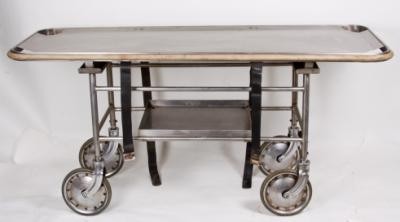
A old gurney—not completely sure what ours will look like
Gotta getta gurney. It's time. We need it. We need to practice hauling bodies around on it. So yesterday my good friend (and resident lighting designer) Rich Streeter (more about him later, I'm sure) stepped up and found one on eBay. He made an offer and the kind gentleman in Ohio accepted, and voila! we have a gurney winging its way toward us. Hurrah.

Thursday, September 27, 2012

Bay of Death

Dale, Randy, and Rod problem solving on the set
Setwise, the look I'm going for with this Richard III: The Terrible Reign set is stark, clinical, and sterile with an undertone of evil. In the adaptation Richard has nearly a dozen people killed during the course of the play, and the word "blood" (or "bloody") occurs over 40 times. That repetition and Richard's brutal actions got me thinking about what metaphor best embodied his character. (The biblical "whited sepulchre" came to mind; however, that image wouldn't transfer well to stage.) In the end, I was inspired by research of old morgues and slaughterhouses. Morgues appear scrupulously clean but are in reality gruesome and sometimes grotesque. Slaughterhouses do a bloody business but can be hosed down and almost all evidence of what's happened there eliminated. I see that as befitting Shakespeare's Richard (who is likely not much like the historical Richard). Richard is all courtesy and polish outwardly but greed, envy, and wickedness inside. Richard has his relatives and "friends" mercilessly murdered but tidies up the business as if nothing untoward has happened—the supreme example being his wooing of Lady Anne over her husband's murdered corpse. (PURIST ALERT: I've done the unpardonable in this adaptation and changed the identity of the corpse from Anne's father-in-law, King Henry VI, to her husband, Edward. Richard killed both. Every time I've ever seen this play on stage or screen, I think that's who it should be, so I changed it.) Our set looks clean but very black—just like Richard. The shiny surface will also reflect light well—especially red light, reinforcing the major theme of blood.

Wednesday, September 26, 2012

Enter KING RICHARD

How 'bout this for doors?
So many costume photos to show. But first, here's a post about the set, which has taken a back seat with all of the costume excitement. I made a quick trip to Home Depot and Lowe's over lunch today and look what I found for some of the doors on the set—grey plastic corrugated sheeting. Perfect. There will be a dozen doors across the back of the set. Lots of doors will make for quick entrances and exits, a key, I think, to making this play (incidentally, the second longest in the canon when performed uncut—this adaptation uses about 60% of the text) move along quickly. I'm eager to see what scenic artist Jason Waggoner can do with several of these plugged into my designs.